
The Regulatory Gamble: Using Options to Bet on Sable Offshore’s Critical Q4 2026 Lifeline
Institutional Investors Paid $5.50: Is Sable Offshore at $4.19 the Ultimate Binary Bet?

Dear friends,
I’m sure most of you are already familiar with the ongoing drama surrounding Sable Offshore, it’s been widely covered here on Substack by investors far sharper than me, so I won’t rehash the backstory.
What I do want to point out, however, is the opportunity presenting itself right now.
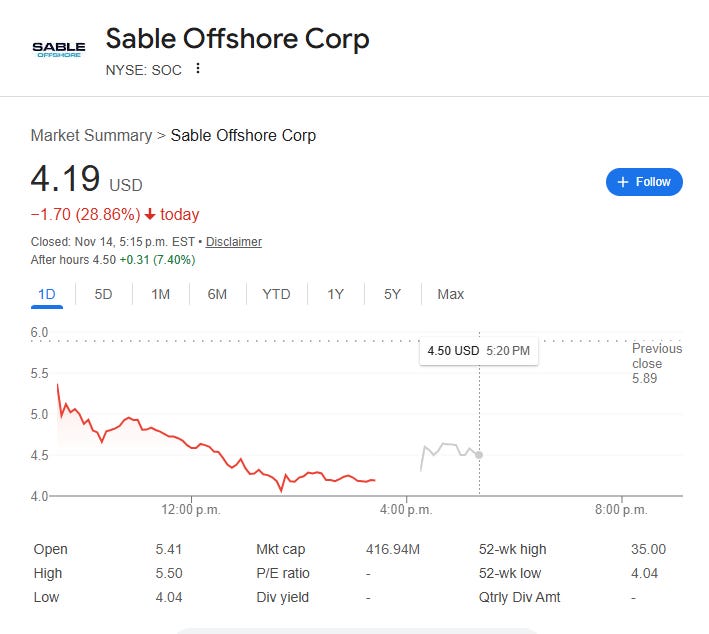
As we speak, Sable Offshore has plunged nearly 30% today, trading around $4.20 per share .
So what now? Why is this an opportunity? What’s new?
to sum it up in a single sentence..
The company controls an oil resource with an unrisked potential value exceeding $10 billion.
This valuation gap is so acute that institutional investors, seemingly undeterred, recently committed to buying shares at $5.50 apiece.
Why …? what are they seeing ? 👀
Lets see the some quick numbers first…
Q3 2025 Shares Outstanding: 99,507,250 shares
New Shares Issued (Private Placement) : 45,454,546 shares
Estimated Shares Outstanding (Post-Placement) : 144,961,796 shares
Current Market Price : $4.19 per share
Estimated Market Capitalization : 607.49 million (144,961,796 shares × $4.19)
Estimated Total Gross Debt (Q3 2025) : $896.6 million (short-term outstanding debt)
Estimated Cash (Post-Placement) : 291.6 million ($41.6M Q3 cash + $250M proceeds)
The current market price of $4.19 per share is significantly lower than the price secured by the company in its recent financing.
The company announced a private placement on November 10, 2025, to institutional investors at a price of $5.50 per share.
This placement, which was expected to close on November 12, 2025, raised gross proceeds of approximately $250 million.
Sable believes the proceeds from the $250 million private placement provide the liquidity required to pursue its objectives, including comprehensive debt refinancing in the first quarter of 2026.
The company ended Q3 2025 with $896.6 million in short-term outstanding debt and $53 million in accounts payable.
The closing of the private placement was expected to satisfy the common equity contribution condition of the Senior Secured Term Loan amendment announced on November 3, 2025.
The market price of $4.19 suggests investors are still discounting the stock due to the uncertainty surrounding the ability to secure the necessary approvals to recommence sales and execute the Q1 2026 debt refinancing.
Now lets look at the 3 Probable Scenarios:
Lets start with the worse..
Scenario 1: The Bear Case (Tails I Lose)
Sable fails to resolve its operational contingencies before its financial pressures become overwhelming.
Necessary regulatory approvals from federal, state, and local regulators for both the OS&T (Option 1) and the Las Flores Pipeline System (Option 2) are not obtained
Production, restarted in May 2025, continues to be stored at the Las Flores Canyon processing facility.
Without commercial sales, the $896.6 million in short-term outstanding debt cannot be serviced or refinanced.
The company is unable to satisfy the common equity contribution condition of the Senior Secured Term Loan amendment, even with the recent capital.
The estimated average monthly cash burn rate of $25MM (excluding OS&T capital expenditures) rapidly depletes the cash reserves.
The company cannot secure the additional financing needed to cover the $450 million required for the OS&T strategy.
It’s Kaput.. Default or restructuring. Equity valuation approaches zero.
Scenario 2: The Base Case
The Base Case assumes Sable successfully resolves the critical hurdles, allowing for the realization of the lowest, most conservative estimate of its resource value.
Sable secures the necessary regulatory approvals and financing to successfully deploy either the Pipeline (Option 2) targeting first sales in Q4 2025 or the OS&T (Option 1) targeting first sales in Q4 2026.
The contingent resources are successfully reclassified as reserves.
The value realized is the Total Low Estimate Contingent Resources of $3.298 billion.
Substantial re-rating as the company moves from a distressed asset to a producing asset with defined reserves.
Scenario 3: The Bull Case (Heads I Win Huge)
The Bull Case assumes optimal execution of the OS&T strategy, achieving maximum resource conversion and realizing the full intrinsic value.
Sable secures the $450 million required capital and successfully implements the OS&T strategy, achieving first sales in Q4 2026.
Sable successfully executes the Development Drilling Program and Development Workover Program, realizing the Total Net Estimated Contingent Resources of 646 MMBoe.
The company realizes the full intrinsic worth: the Total Blended NAV of $10.029 billion
Explosive growth in equity value.
Okay now what … ? How should i play this with minimum downside?
This Sable Offshore investment scenario is fundamentally a high-stakes, binary gamble on regulatory success and financial restructuring.
Playing this with minimum downside while aiming for maximum upside is precisely the reason a long-dated, deep-in-the-money call option strategy is the appropriate vehicle.
The “Minimum Downside” Strategy: The Long dated Call Option
By limiting your maximum financial exposure to the capital committed for the trade.
By purchasing a call option, such as the proposed Jan 2027 call with a $2.50 strike, your maximum possible loss is strictly the premium paid for that contract, regardless of how severe the Bear Case becomes.
Basically setting up a Low Barrier to Success
The underlying stock only needs to remain above $2.50 for the option to retain intrinsic value.
Given that institutional investors recently paid $5.50 per share in the private placement, the $2.50 strike acts as a deep cushion against market volatility
The Jan 2027 expiration date is strategically crucial because it grants time for Sable to execute all critical milestones and resolve the contingencies identified in the sources.
If Sable executes the Base or Bull Case, the call option provides significantly enhanced leverage.
SABLE’S RUNWAY

Ideally, Sable Offshore Corp.’s (SOC) runway is not just measured in months of cash, but in the time they have bought to successfully execute two critical projects: financial stability and restarting commercial oil sales.
In simple language, Sable’s runway is the time they have purchased to reach the revenue gate before their existing clock runs out.
Sable estimates its average monthly operational cash burn is $25M
The ultimate goal of the runway is to reach the point of “first sales,” at which point the runway becomes self-sustaining and powered by revenue.
Sable has two planned routes to reach that revenue gate:
The Fast Track (Pipeline): If they successfully receive the final regulatory approvals from California, they could potentially achieve first sales through the existing onshore pipelines by Q4 2025. This is the quickest way to end the cash burn and begin generating revenue.
The Strategic Track (OS&T Vessel): Their primary long-term plan is to purchase and implement an Offshore Storage and Treating Vessel (OS&T). The ideal timeline for this strategic project is to secure the vessel by Q1 2026 and achieve first sales in Q4 2026
The Idealistic Outcome
Idealistically, the $250 million runway provides the company enough financial capacity to:
1. Survive the monthly burn through 2026.
2. Execute the mandatory debt refinancing in Q1 2026.
3. Fund the initial steps of the OS&T strategy (which requires $450 million total capital).
4. Reach the Q4 2026 sales target
If Sable successfully hits the Q4 2026 sales target and converts its trapped oil into revenue, the runway effectively becomes unlimited, powered by the cash flow from the vast Santa Ynez Unit resource.
Cheers
Sri
* This is not an Investment advise.